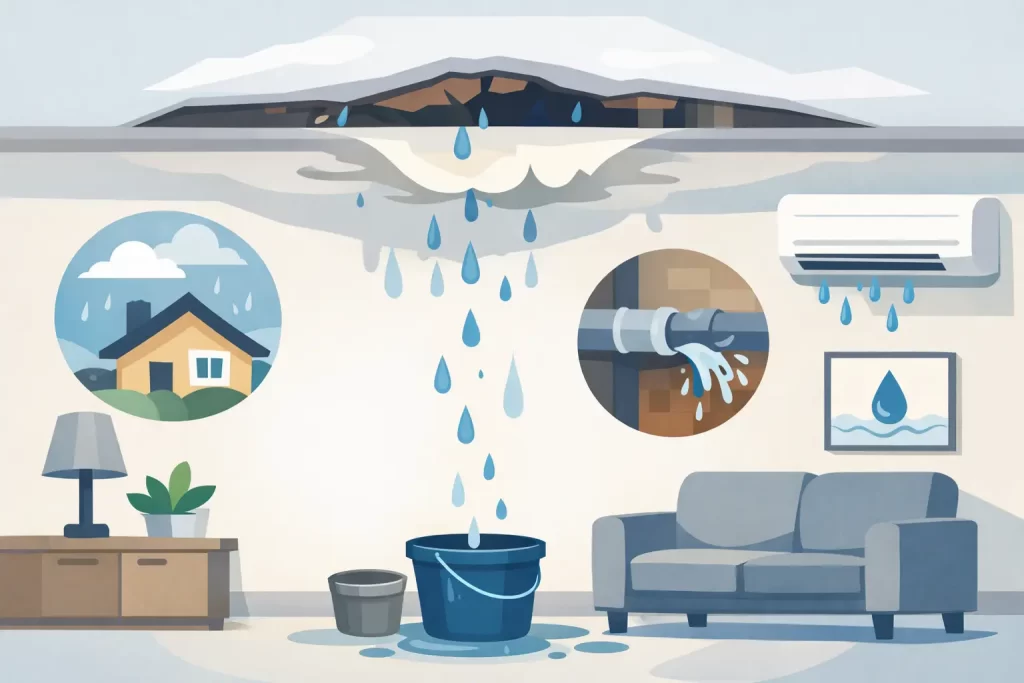
A ceiling leak usually shows up at the worst possible time – during a hard rain, after a storm, or right when you think a small stain can wait. If you are asking, “why does my ceiling leak,” the frustrating part is that the water you see is not always coming from directly above that spot. Water travels. It can enter through one weak point and show up several feet away, which is why ceiling leaks are often misdiagnosed.
In Central Texas, we see this all the time. A homeowner notices a brown ring, peeling paint, or a drip near a light fixture and assumes the roof shingles are the problem. Sometimes that is true. Just as often, the real cause is failed flashing, a cracked vent boot, clogged gutters, deteriorated sealants, chimney issues, wall transitions, or even an HVAC or plumbing problem. The visible damage is only the symptom. The real job is finding the entry point and fixing it correctly.
Why does my ceiling leak during rain?
If the leak gets worse during rain or only appears during storms, the most likely cause is water intrusion from the exterior. That usually means the roof system, flashing details, penetrations, or drainage components are no longer shedding water the way they should.
Roof age is one of the biggest factors. As roofing materials age, they become less reliable at resisting wind-driven rain and standing water. Shingles can crack, lift, or lose granules. Flat and low-slope roof membranes can split or pull apart at seams. Even a small failure can let water into the roof assembly, where it moves along decking or framing before reaching the ceiling below.
Flashing problems are another common culprit. Flashing is the metal or waterproof material installed around roof transitions, chimneys, skylights, vents, and wall intersections. When flashing is loose, rusted, improperly installed, or sealed with the wrong material, water can bypass the roof covering and enter the structure. We often find that a leak blamed on the main roof is actually coming from a failed flashing detail.
Gutters also matter more than many property owners realize. If gutters are clogged or undersized, rainwater can back up and push beneath roofing edges or overflow against fascia, soffits, and exterior walls. That trapped water can eventually show up as a ceiling stain inside. In some homes, the leak is not a roofing failure at all – it is a drainage failure.
The most common causes of a leaking ceiling
When clients ask why does my ceiling leak, we usually narrow it down by looking at when the leak appears, where it shows up, and what building components are nearby. The most common causes include roof damage, failed flashing, window or wall leaks, clogged gutters, plumbing leaks, and HVAC condensation issues.
A damaged roof is the obvious place to start, but not the only place. Missing shingles, punctures, deteriorated membranes, and storm damage can all allow water in. In Austin, strong sun exposure also shortens the life of many sealants and roofing materials, especially on areas that were patched previously with low-grade products.
Plumbing leaks can mimic roof leaks. If the ceiling stain sits below a bathroom, kitchen, or mechanical room, a supply line, drain line, shower pan, or appliance connection may be the source. These leaks can be steady or slow, and they often continue even when the weather is dry. That is one of the clearest clues that the problem may be inside the building rather than on the roof.
HVAC systems are another possibility. A clogged condensate drain line, rusted drain pan, or poorly insulated duct can create enough moisture to stain or drip through a ceiling. This is especially common in attics and around second-floor mechanical equipment. It is easy to mistake this for rainwater if the timing overlaps with humid weather.
Then there are wall and window leaks, which are often overlooked. Water can enter around failed window perimeter sealants, cracks in exterior walls, deck attachments, or wall penetrations and travel downward into ceiling cavities. In those cases, replacing roof materials will not solve the problem because the roof was never the source.
Signs your ceiling leak is more serious than it looks
A small stain does not always mean a small problem. Sometimes the ceiling is just the first visible sign of long-term water intrusion that has already affected insulation, framing, drywall, or interior finishes.
If the stain is expanding, the paint is bubbling, or the drywall feels soft, the leak has likely been active for a while. Musty odors can point to trapped moisture above the ceiling. Sagging drywall is more urgent because it can indicate water pooling overhead, which creates both a collapse risk and potential electrical hazards if fixtures or wiring are nearby.
Recurring leaks are another warning sign. If a stain was painted over, patched cosmetically, or repaired once and came back, the original source may not have been identified. This happens often with complex leaks where water enters in one place and appears somewhere else. Quick fixes can temporarily slow the symptom while the intrusion continues behind the scenes.
What to check first when your ceiling starts leaking
Start by protecting the interior. Move furniture, place a bucket under active drips, and if water is near a light fixture or electrical device, turn off power to that area if it is safe to do so. Then pay attention to timing. Does it leak only during rain, right after rain, or even in dry weather? That detail helps narrow the source.
Look at the ceiling area itself. Note whether the stain is near a chimney, vent pipe, skylight, exterior wall, upstairs bathroom, or HVAC equipment. Check the attic if you can do so safely. Wet insulation, darkened wood, mold growth, or visible dripping can provide valuable clues, though the exact entry point may still be higher up or farther away.
Outside, look for obvious issues such as missing shingles, overflowing gutters, cracked pipe boots, open flashing seams, or gaps around wall penetrations. The key word is obvious. Walking on a roof without the right experience is risky, and many leak sources are not visible from the ground.
Why leak diagnosis is where most repairs go wrong
The hardest part of ceiling leak repair is not always the repair itself. It is diagnosis. Water intrusion is deceptive, and the visible damage rarely tells the full story. A contractor who treats every ceiling leak like a simple roof patch can miss the actual failure point.
That is why specialized leak detection matters. The right approach looks at the entire water path – roofing, flashing, gutters, walls, sealants, penetrations, and drainage patterns. It also considers construction details. Some leaks happen because a material failed over time. Others happen because the original installation was wrong from day one.
There is also a cost factor. Guessing at repairs gets expensive fast. Replacing shingles when the problem is chimney flashing wastes money. Recaulking a vent when the leak is coming through a wall transition does the same. Accurate diagnosis usually saves more than it costs because it avoids repeat damage and repeat repairs.
When to call a specialist for a leaking ceiling
If the leak is active, recurring, or has already caused interior damage, it is time to bring in a specialist. The same applies if you have already tried one repair and the problem came back. Water intrusion does not usually improve on its own. It spreads, damages more materials, and creates a bigger repair scope the longer it is left alone.
For homeowners and property managers in Austin, this is especially true after heavy rain events. One storm can expose several weak points at once, and the first visible leak may not be the only one. A focused inspection can determine whether you are dealing with roof damage, flashing failure, wall leakage, drainage backup, or an interior mechanical issue.
Rainwater Restoration & Waterproofing handles this type of work every day, and the value is not just in patching the symptom. It is in finding the actual source, using the right repair method, and helping you avoid the cycle of stain, patch, and repeat.
A leaking ceiling is stressful, but it is also a warning you can act on. The sooner the source is identified, the better your chances of limiting damage, controlling cost, and getting back to a dry, dependable building.